
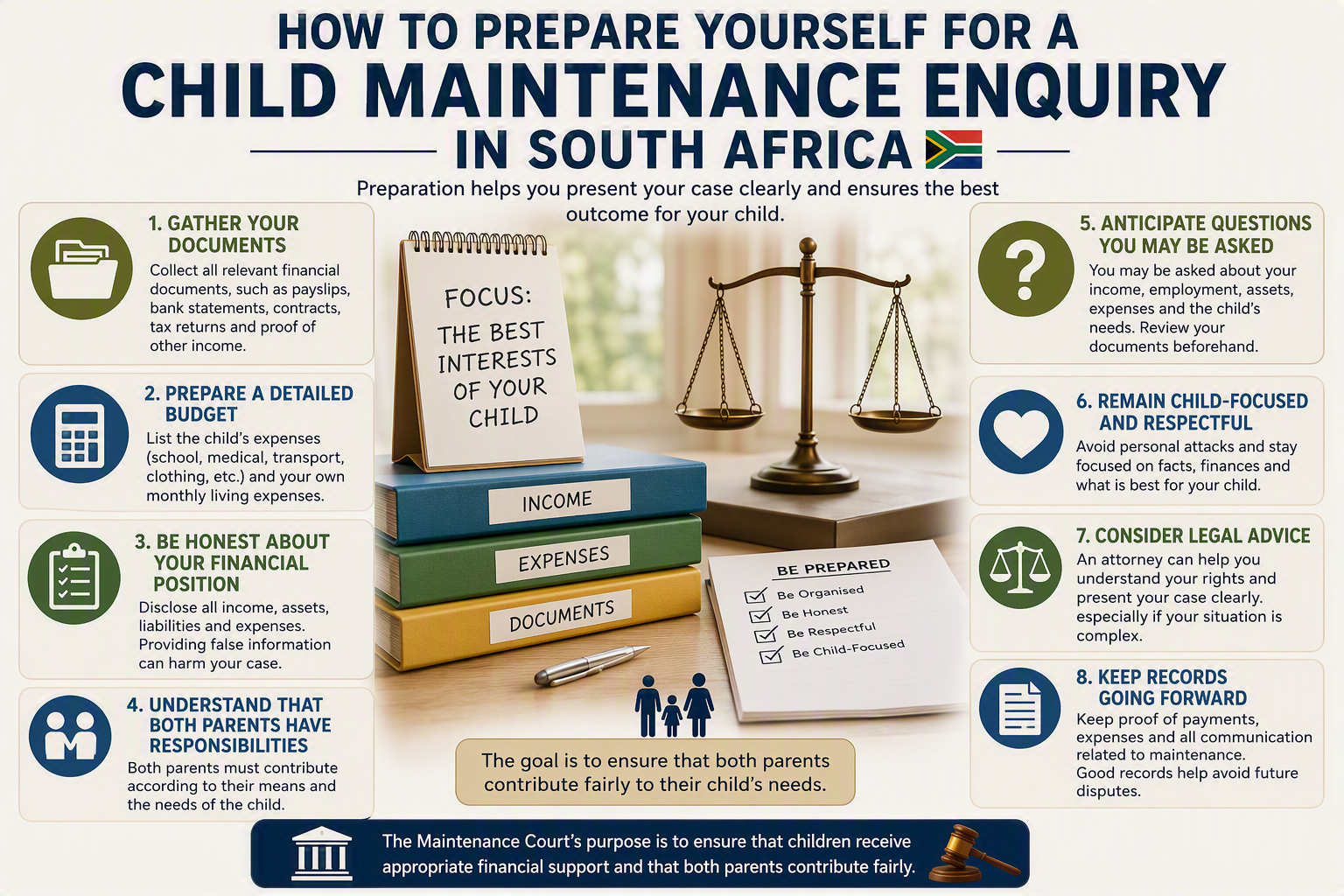
How to Prepare Yourself for a Child Maintenance Enquiry in South Africa
A child maintenance enquiry can feel intimidating, especially if you have never appeared in the Maintenance Court before. However, proper preparation can make the process less stressful and help ensure that the court receives an accurate picture of your financial circumstances and your child’s needs.
Understanding the Purpose of the Enquiry
The purpose of a child maintenance enquiry is to determine what financial contribution each parent should make towards the support of their child. In South African law, both parents have a duty to support their children according to their respective means and the reasonable needs of the child.
The court does not focus on punishing either parent. Instead, it seeks to establish a fair maintenance amount based on factors such as:
- The child’s reasonable monthly expenses.
- Each parent’s income and earning capacity.
- Each parent’s assets and liabilities.
- The child’s standard of living.
- Any special needs, including educational or medical expenses.
Gather Your Financial Documents
One of the most important steps is to collect all relevant financial documentation before attending the enquiry. Arriving with complete and organised records demonstrates credibility and assists the court in making an informed decision.
Documents may include:
- Recent payslips.
- Employment contracts.
- Bank statements for the past three to six months.
- Income tax returns.
- Proof of bonuses or commissions.
- Rental income statements.
- Dividend or investment income records.
- UIF or social grant documentation, if applicable.
- Medical aid statements.
If you are self-employed, bring:
- Business financial statements.
- Invoices and proof of income received.
- Business bank statements.
- Records of operating expenses.
Prepare a Detailed Budget
Whether you are the parent claiming maintenance or the parent responding to the claim, you should prepare a realistic monthly budget.
Child’s Expenses
Prepare a comprehensive list of the child’s expenses, including:
- School fees.
- Uniforms and stationery.
- Transport costs.
- Medical expenses.
- Clothing.
- Food.
- Extramural activities.
- Cellphone and internet costs.
- Childcare expenses.
Whenever possible, support these expenses with receipts, invoices or quotations.
Your Personal Expenses
The court may also consider your own financial position. Prepare an honest record of:
- Housing costs.
- Bond or rental payments.
- Utility costs.
- Vehicle expenses.
- Insurance premiums.
- Debt repayments.
- Medical expenses.
Avoid exaggerating expenses, as this may undermine your credibility.
Be Honest About Your Financial Position
Many maintenance disputes arise because one party believes the other is concealing income or assets.
The Maintenance Court may require parties to disclose:
- Employment details.
- Bank accounts.
- Property ownership.
- Business interests.
- Investments.
Providing inaccurate information can negatively affect your case and may result in adverse findings by the court.
Understand That Both Parents Have Responsibilities
A common misconception is that only one parent bears financial responsibility for a child. South African law requires both parents to contribute according to their means.
The court will generally examine:
- What each parent earns.
- What each parent can realistically afford.
- The actual needs of the child.
The enquiry is therefore not simply about what one parent should pay, but about how both parents should contribute.
Anticipate Questions You May Be Asked
You may be questioned about:
- Your employment status.
- Your monthly income.
- Your expenses.
- Your assets and liabilities.
- Additional sources of income.
- The child’s specific needs.
- Existing maintenance arrangements.
Consider reviewing your documents beforehand so you can answer confidently and accurately.
Remain Child-Focused
Maintenance proceedings can be emotionally charged, particularly when there is conflict between parents. However, the enquiry is primarily concerned with the best interests of the child.
Try to avoid:
- Personal attacks on the other parent.
- Discussions unrelated to maintenance.
- Arguments about past relationship issues.
Focus on facts, finances and the child’s needs.
Consider Legal Advice
While many people attend maintenance enquiries without legal representation, consulting an attorney or advocate beforehand can be beneficial, particularly if:
- The financial circumstances are complex.
- One parent is self-employed.
- There are disputes about hidden income or assets.
- A variation of maintenance is being sought.
- There are substantial arrears.
A legal practitioner can assist in presenting financial information clearly and ensuring that relevant evidence is placed before the court.
Maintain Proper Records Going Forward
After the enquiry, keep records of:
- Maintenance payments made or received.
- Bank transfer confirmations.
- Written agreements.
- School and medical expenses.
- Communications relating to maintenance.
Good recordkeeping can be invaluable if future disputes arise or if a variation application becomes necessary.
Final Thoughts
A child maintenance enquiry is not something to fear. Careful preparation, complete financial disclosure and a focus on the child’s best interests can significantly improve the process. Parents who arrive organised, informed and ready to provide documentary proof of their financial circumstances are generally better positioned to assist the court in reaching a fair and sustainable maintenance order.
Ultimately, the goal of the Maintenance Court is to ensure that children receive appropriate financial support and that both parents contribute fairly according to their means.